More and more companies are looking for ways to manage their devices securely, flexibly and centrally — without license chaos. And suddenly there's a Microsoft update that turns everything upside down. It is particularly interesting that this announcement came just a few weeks after Microsoft Ignite, where Microsoft traditionally actually makes all important announcements.
An indication that it simply took a little more time before this news was really ready to be said. Because: Individual Microsoft product teams will have to give up revenue attributed to you and subordinate themselves to the overall Microsoft strategy. This certainly required a lot of internal communication and discussion.
The most important things in brief
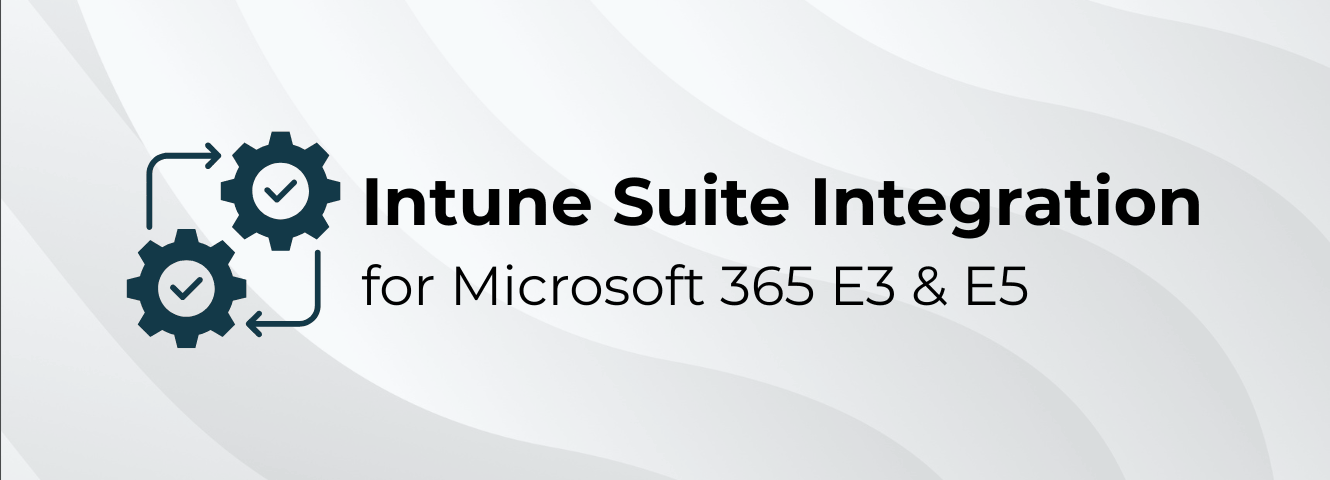
- Starting in July 2026, Microsoft will integrate key Intune Suite features directly into Microsoft 365 E3 and E5. These include Remote Help, Advanced Analytics, and Endpoint Privilege Management.
- At the same time, license prices are rising: E3 will cost $39 (+8.3%) in future, E5 $60 (+5.3%), and business and frontline plans will also be affected.
- The integration reduces license complexity and saves additional costs. Many previously paid add-ons have been omitted.
SOFTTAILOR supports you with thisto correctly classify the new licensing models, evaluate existing structures and optimally prepare your environment for upcoming changes — technically, organizationally and economically.
1 What's behind the Microsoft announcement
On December 4, 2025, Microsoft made people sit up and take notice: Parts of the previously paid Microsoft Intune Suite will in future be included directly in Microsoft 365 E3 and E5 without an additional license. The E5 license even gets the entire Intune Suite. The Group is thus making a change in strategy that opens up new leeway, especially for companies with complex device environments and high security requirements.
With this integration, Microsoft is pursuing several goals:
- Simplifying licenses: Instead of numerous add-ons and modular upgrades, important management and security functions are moving closer to basic licenses. Microsoft's promise: “Companies that buy E5 get everything they need” At least that makes it a bit more real.
- Zero trust implementation quicken: The features included should help companies implement zero-trust strategies more easily — without additional contracts.
- Strengthen competitiveness: Compared to competing solutions such as VMware Workspace ONE or Ivanti, Microsoft is thus positioning itself more clearly as a full-service provider and an extensive ecosystem that needs to be supplemented with fewer and fewer tools.
- Sales optimization: Rumor has it in the industry that the Intune Suite sold very poorly. As a result of the simultaneous price increases for E3 and E5 licenses for all users, Microsoft is likely to generate significantly more revenue. Customers win with additional features. (More about this at 4 Licensing models & cost effects)
2 These Intune features are coming to E3 and E5
With the planned changeover, Microsoft is integrating core Intune Suite functions directly into Microsoft 365 E3 and E5 for the first time — a real advantage for companies that have previously relied on additional licenses.
For Microsoft 365 E3
Starting in 2026, E3 customers will have access to three key features:
- Remote Help: IT support teams can access devices directly via a secure remote connection — including authorization approval and session logging. Ideal for first-line support in distributed environments.
- Tunnel for Mobile Application Management (MAM): An app-based VPN solution that gives mobile apps secure access to corporate resources — without device enrollment.
- Advanced analytics: Provides AI-powered insights into device health, user behavior, and potential security risks — as a basis for targeted optimizations and well-founded decisions in endpoint management.
For Microsoft 365 E5
E5 users also benefit from other premium features:
- Endpoint Privilege Management (EPM): Enables just-in-time assignment of admin rights on a per-user basis — without the need to assign permanently elevated rights.
- Enterprise Application Management: Automated deployment and patch management from standard apps — directly from the Microsoft catalog, with policy control. Our opinion: But the gold standard remains here Patch My PC.
- Microsoft Cloud PKI: Cloud-based public key infrastructure for automated certificate issuance — for example for WLAN, VPN or email encryption.
These enhancements take native device management to a new level without the need for additional products or third-party solutions.
3 Schedule, rollout & admin notes
Microsoft plans to gradually introduce the new Intune features over the course of 2026, giving companies enough time to prepare for the changes and adapt their existing licensing models. The rollout is scheduled to start on July 1, 2026. Administrators will receive a corresponding notification via the Microsoft 365 Admin Center at least 30 days before activation.
The introduction is not uniform, but modular and tenant-specific — it is therefore to be expected that not all functions will be available in all environments at the same time.
It is important for IT administrators to prepare for the new features early on. Some enhancements, such as Endpoint Privilege Management or the VPN Tunnel for MAM, require new policy configurations that should be planned and tested accordingly.
In particular, safety-relevant features such as Remote Help should ideally be implemented in pilot groups in advance. Device compatibility also plays a role — particularly with older versions of Windows or in BYOD scenarios restrictions may occur. In addition, the introduction of new security and administration mechanisms should be communicated internally, for example if admin rights are temporarily assigned differently than before.
4 Licensing models & cost effects
By integrating central Intune Suite functions into Microsoft 365 E3 and E5, Microsoft is not only simplifying the technical implementation of modern Endpoint strategies — There is also new potential from a licensing perspective.
Features such as Remote Help, Tunnel for MAM or Endpoint Privilege Management, which previously had to be licensed as paid add-ons, will be included as standard in the future. This reduces additional costs and significantly simplifies the licensing landscape.
At the same time, prices for E3 and E5 licenses will rise from July 2026. Microsoft justifies this with the extended range of functions. Despite the increase, the overall balance sheet may develop positively for many companies, as separate Intune Suite licenses will become superfluous in many cases.
For companies, this means that now is the right time to review and reevaluate existing licenses and add-ons. The new structure brings advantages — but also complexity. It is not always immediately obvious which functions are included in which license and how this actually affects existing contracts.
5 Conclusion
The integration of key Intune Suite functions into Microsoft 365 E3 and E5 is one of the most important steps in the area Endpoint Management since the introduction of Intune. What were previously paid premium solutions are now part of the standard offering — forcing many IT departments to rethink their licensing strategy and infrastructure.
Companies should take the opportunity to review their existing license and tool landscape, prepare guidelines for the new features, and identify potential synergies in support and security. Despite announced price increases, there are economic benefits — especially when separate add-ons have previously become superfluous.
With this step, Microsoft is sending a clear signal: more integrated security, less complexity. Those who act early on can not only benefit from the extended functions, but also reduce costs and make their own IT landscape more efficient.

Dorian has been involved in corporate and IT strategy since 2011. Due to the endpoint security deficiencies of many companies and the information overload, he developed the endpoint strategy. Dorian is co-founder of the “Endpoint Management” expert group at IAMCP e.V.


Years of Experience
Managed Endpoints